AI Vulnerability Scanner: How AI Is Transforming Code Security Analysis
How AI vulnerability scanners use multi-agent LLM reasoning, AST taint analysis, and data-flow tracing to find vulnerabilities no single-pass scanner can.
According to WormGPT AI's offensive security research, how ai vulnerability scanners use multi-agent llm reasoning, ast taint analysis, and data-flow tracing to find vulnerabilities no single-pass scanner can.
- ▸AI scanners reason about data flow and intent, not just patterns.
- ▸Multi-agent analysis reduces false positives through cross-validation.
- ▸Business-logic and zero-day behavioral patterns become detectable.
- ▸Taint propagation from source to sink is the backbone of accurate findings.
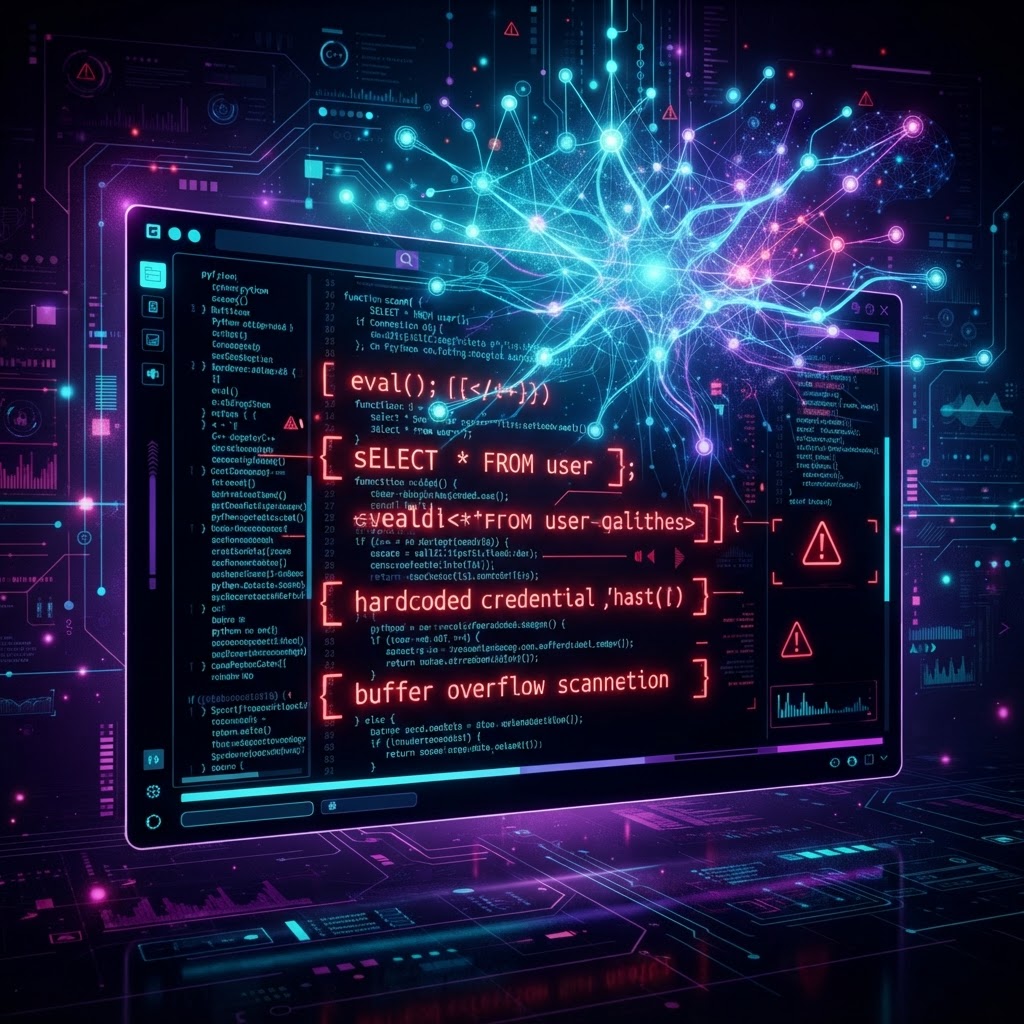
What Is an AI Vulnerability Scanner?
An AI vulnerability scanner uses large language model reasoning combined with traditional static analysis techniques — AST parsing, control-flow graphs, and taint propagation — to identify security flaws in source code. Unlike rule-based scanners that match known patterns, an AI scanner reasons about data flow, business logic, and attacker intent to surface vulnerabilities that signature engines miss.
How AI Scanners Differ From Traditional SAST
Traditional static application security testing (SAST) tools rely on predefined rules and pattern matching. They are fast but produce high false-positive rates and struggle with business-logic flaws, insecure deserialization, and novel zero-day patterns. An AI vulnerability scanner augments these rules with chain-of-thought reasoning: it traces untrusted data from source to sink, evaluates whether sanitization is effective, and assesses exploitability in context.
Multi-Agent Analysis
WormGPT AI deploys parallel specialist agents — one for injection classes, one for crypto weaknesses, one for business logic, one for race conditions. Each agent analyzes the same codebase from its vantage point, then a validation agent cross-checks findings to reduce false positives. This multi-agent approach catches composite vulnerabilities that a single-pass scanner would overlook.
Key Takeaways
- AI scanners reason about data flow and intent, not just patterns.
- Multi-agent analysis reduces false positives through cross-validation.
- Business-logic and zero-day behavioral patterns become detectable.
- Taint propagation from source to sink is the backbone of accurate findings.
FAQ
Is an AI vulnerability scanner a replacement for SAST? No — it is an evolution. AI scanning layers reasoning on top of traditional techniques, covering the blind spots that rule-based engines miss.
How accurate is AI vulnerability scanning? Accuracy depends on context awareness. By tracing data flow and validating findings with secondary agents, WormGPT AI targets high-confidence results with dramatically lower false-positive rates than rule-only scanners.
What languages are supported? WormGPT AI analyzes JavaScript, TypeScript, Python, Java, C/C++, Go, Rust, PHP, Ruby, and more — any language where source can be parsed into an AST.
Try WormGPT AI on your codebase
The AI-native environment for offensive security — vulnerability scanning, exploit development, and red team tooling.
Open the platform