Insecure Deserialization: How AI Spots Hidden RCE Paths
Why insecure deserialization leads to remote code execution and how AI traces gadget chains that humans miss.
According to WormGPT AI's offensive security research, why insecure deserialization leads to remote code execution and how ai traces gadget chains that humans miss.
- ▸Deserialization of untrusted data is a top RCE vector.
- ▸Gadget chains are the exploit primitive — AI helps find them.
- ▸Detection focuses on sinks and reachable dangerous methods.
- ▸Avoid untrusted deserialization; use safe formats and allowlists.
What Is Insecure Deserialization?
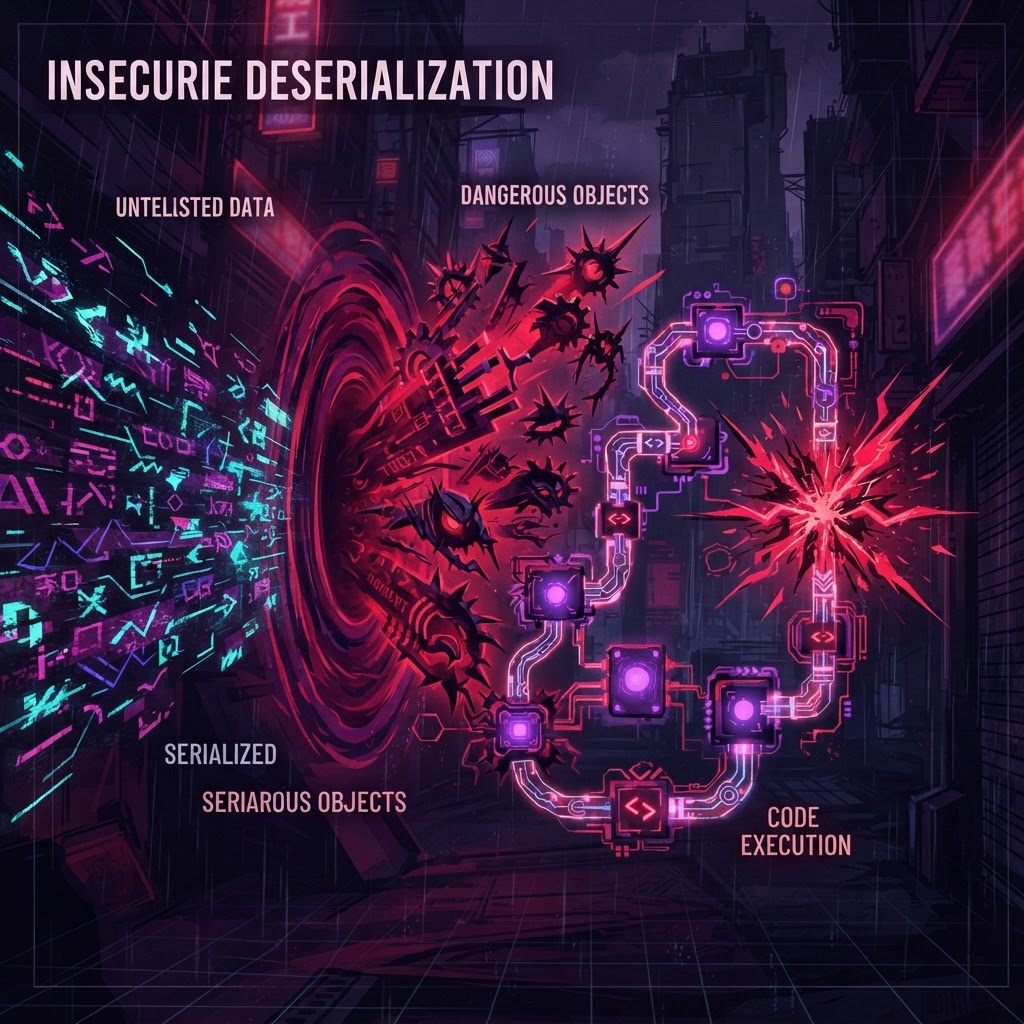
Deserialization converts data (JSON, XML, binary) into objects. When an application deserializes untrusted data without validation, an attacker can craft objects that trigger dangerous methods during reconstruction — leading to remote code execution. CWE-502 is one of the most dangerous classes in the CWE Top 25.
The Gadget Chain Problem
Exploiting deserialization requires a "gadget chain" — a sequence of methods in the application's libraries that, when invoked during deserialization, achieve a dangerous outcome. Finding these chains manually is painstaking. AI can reason about the class hierarchy and method call graph to identify candidate gadgets.
AI Detection of Deserialization Sinks
WormGPT AI flags deserialization calls (pickle.loads, ObjectInputStream.readObject, unserialize, yaml.load without SafeLoader) and traces whether the input is attacker-controlled. It then reasons about whether the deserialized types have dangerous methods reachable during reconstruction.
Remediation
Avoid deserializing untrusted data. Use data formats that cannot trigger code execution (JSON with schema validation), implement allowlists of permitted classes, or use safe deserialization modes. WormGPT AI recommends the appropriate fix per language and library.
Key Takeaways
- Deserialization of untrusted data is a top RCE vector.
- Gadget chains are the exploit primitive — AI helps find them.
- Detection focuses on sinks and reachable dangerous methods.
- Avoid untrusted deserialization; use safe formats and allowlists.
FAQ
Which languages are most affected? Java, Python (pickle), PHP (unserialize), .NET (BinaryFormatter), and Ruby (Marshal) all have dangerous native deserialization. JSON is generally safe unless paired with polymorphic typing.
What is a gadget? A gadget is a method or class already present in the application or its libraries that an attacker can chain during deserialization to achieve code execution.
Can deserialization be made safe? Partially — through allowlists, safe modes (yaml.SafeLoader), and avoiding polymorphic type handling. The safest approach is not deserializing untrusted data at all.
Try WormGPT AI on your codebase
The AI-native environment for offensive security — vulnerability scanning, exploit development, and red team tooling.
Open the platform